
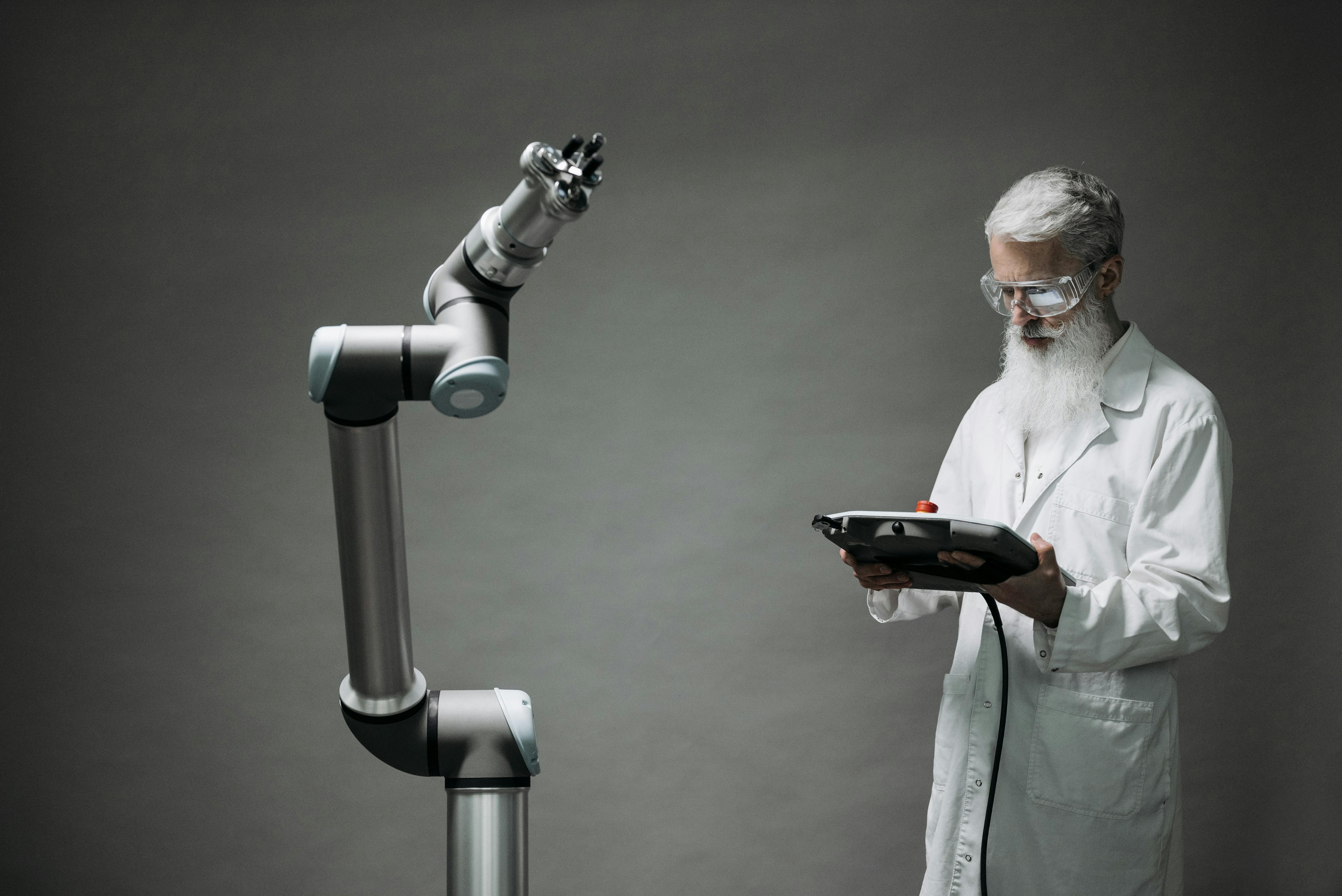
Can We Build Our Own Helix? A Practical Guide to Starting Small with Vision-Language-Action Models
The dream of intelligent robots, capable of understanding and interacting with our world as seamlessly as humans, has captivated us for decades. From science fiction to cutting-edge research labs, the quest to build truly autonomous agents — a “Helix” of embodied intelligence — is rapidly evolving. Today, thanks to breakthroughs in Vision-Language-Action (VLA) models like Google’s RT-2 and the emerging open-source ecosystem exemplified by projects like OpenHelix, this ambitious vision is becoming more tangible. But how do we, the enthusiasts, the hobbyists, the small-scale innovators, even begin to approach such a monumental task? The answer, as with many complex endeavors, lies in starting small, experimenting, and building incrementally. This guide offers a practical roadmap for anyone looking to dip their toes into the fascinating world of VLA models on modest robotic platforms, laying the groundwork for future, more sophisticated AI.
The Grand Vision: From Reactive Bots to Embodied Intelligence
For years, robotics has excelled in specialized tasks. Industrial arms precisely welding car parts, autonomous vacuum cleaners navigating homes, or drones performing aerial surveillance – these are marvels of engineering. However, these robots often operate within highly structured environments or rely on explicit programming for every conceivable scenario. The leap to truly intelligent, general-purpose robots requires something more profound: the ability to perceive the world, understand human language, reason about complex situations, and translate that understanding into meaningful physical actions. This is the essence of Vision-Language-Action (VLA) models. Imagine a robot that can understand “Please grab the red mug from the table,” not because it’s programmed for “red mug” at “table,” but because it sees the mug, understands “red” and “mug,” locates the table, and infers the action “grab.” This integrated understanding is what defines embodied intelligence, paving the way for the “humanoid-level AI” that so many envision.
Why Start Small? The Pragmatism of Incremental Innovation
While the ultimate goal might be a sophisticated humanoid robot assisting in complex environments, jumping directly to such a project is often impractical for individuals or small teams. The challenges of hardware cost, computational power, safety, and the sheer complexity of integrating numerous advanced systems can be overwhelming. Starting small offers several crucial advantages:
- Accessibility: Leveraging off-the-shelf components and smaller, more manageable robotic platforms significantly lowers the barrier to entry.
- Cost-Effectiveness: Reduced hardware and compute requirements make experimentation financially feasible.
- Focused Learning: Smaller projects allow for deeper focus on specific VLA concepts without being bogged down by the intricacies of a full-scale humanoid.
- Rapid Iteration: It’s easier and faster to build, test, and refine models on a simpler system.
- Safety: Experimenting with smaller, less powerful robots inherently reduces potential risks during development.
Think of it as learning to walk before you run, or building a strong foundation before erecting a skyscraper. Each small success builds confidence and provides invaluable insights that will be crucial when scaling up.
Understanding Vision-Language-Action Models: RT-2 and Beyond
At its core, a VLA model bridges the gap between different modalities: visual perception (what the robot sees), linguistic understanding (what it’s told or reads), and motor control (how it moves). Traditional approaches often treated these as separate components. VLA models aim to learn a unified representation that allows them to reason across these domains.
How They Work (Simplified)
Many modern VLA models are built upon large language models (LLMs) and large vision models (LVMs), often leveraging transformer architectures. The key innovation is how they are trained to connect language commands with visual observations and then generate a sequence of low-level robot actions.
- Tokenization: Both visual data (e.g., image patches) and linguistic commands are converted into numerical “tokens.”
- Unified Representation: A transformer network processes these tokens, learning relationships between them across modalities. It learns to associate specific visual patterns with linguistic descriptions (e.g., “red mug”) and to predict a sequence of actions required to achieve a goal.
- Action Generation: Based on the integrated understanding, the model outputs a sequence of action tokens that can be translated into robot commands (e.g., joint angles, gripper commands, navigation waypoints).
RT-2 (Robotic Transformer 2), developed by Google DeepMind, is a prime example. It demonstrates how training an LLM on vast amounts of web data and robot data allows it to generalize to new, unseen tasks with remarkable few-shot learning capabilities. It essentially transforms internet-scale knowledge into robotic actions.
On the open-source front, projects like OpenHelix are emerging, aiming to provide accessible frameworks and pre-trained models for the community to experiment with VLA. While still nascent, these initiatives are crucial for democratizing access to this powerful technology.
Your Practical Roadmap: Starting Small
Ready to embark on your VLA journey? Here’s a step-by-step guide to setting up your first small-scale VLA robot.
Step 1: Choose Your Robotic Platform
Your “small robot” doesn’t need to be complex. Excellent choices for beginners include:
- Desktop Robot Arms: Affordable and easy to control, perfect for manipulation tasks (e.g., picking and placing objects). Examples: UFACTORY xArm 1S, Elephant Robotics myCobot.
- Small Mobile Robots: Wheeled platforms like TurtleBot, GoPiGo, or even custom Raspberry Pi-based robots are great for navigation and simple interaction.
- Simulated Environments: If hardware is a barrier, start with a simulator (e.g., Gazebo, Isaac Gym, PyBullet). This allows you to experiment with VLA models without any physical robot.
Focus on a platform that allows for basic perception (a camera) and action (movable joints or wheels).
Step 2: Hardware and Compute Considerations
Even for small-scale VLA, some processing power is required.
- Onboard Compute: A Raspberry Pi 4 or an NVIDIA Jetson Nano/Orin Nano can handle basic inference for smaller VLA models. For more demanding tasks, you might offload inference to a more powerful PC.
- Sensors: A standard USB webcam is often sufficient for visual input. Depth cameras (like Intel RealSense) can provide richer 3D information but are not strictly necessary for initial experiments.
- Actuators: Ensure your robot’s motors and grippers are controllable programmatically.
- Power Supply: Reliable power is crucial for continuous operation.
Step 3: Set Up Your Software Stack
A robust software foundation is key.
- Operating System: Linux (Ubuntu is common for robotics) is highly recommended.
- Robot Operating System (ROS/ROS 2): While not strictly mandatory for every project, ROS (or ROS 2) provides a standardized framework for robot communication, sensor drivers, and actuator control. It simplifies the integration of different hardware components.
- Python: The language of choice for AI and robotics.
- Machine Learning Frameworks: PyTorch or TensorFlow are essential for working with VLA models.
- VLA Libraries/Models:
- Open-source LLMs/LVMs: Explore pre-trained models from Hugging Face Transformers. You’ll likely need to fine-tune these or integrate them into a VLA pipeline.
- Robot-specific VLA Implementations: Keep an eye on projects like OpenHelix, or researchers releasing simplified versions of models like RT-2 for community use. You might start by adapting existing vision-language models for a robotic context by adding an action output layer.
Step 4: Data Collection and Annotation (or Leverage Existing Datasets)
Training a VLA model requires data pairing visual observations, language commands, and corresponding robot actions.
- Simulated Data: Much easier and faster to generate. You can create environments in Gazebo or MuJoCo and record trajectories with corresponding language instructions.
- Real-World Data (Small Scale): For your small robot, you can manually guide it through tasks while recording camera feeds, motor commands, and typing out natural language descriptions of the goal. This is tedious but provides real-world grounding.
- Leverage Existing Datasets: Publicly available robotics datasets (e.g., from academic research) can be a great starting point for transfer learning, even if they aren’t perfectly aligned with your specific robot.
Step 5: Training and Fine-Tuning Your VLA Model
This is where the magic happens.
- Transfer Learning: Instead of training a VLA model from scratch (which requires massive datasets and compute), leverage pre-trained vision-language models. You can then fine-tune the final layers or adapt the entire model on your robot-specific data.
- Model Architecture: Start with simpler architectures or adapt existing VLA model examples. Focus on connecting visual features and language embeddings to a robot action space (e.g., joint angle predictions, end-effector poses, or discrete action commands).
- Reinforcement Learning (Optional): For more complex or open-ended tasks, reinforcement learning can be integrated, where the robot learns optimal actions through trial and error, guided by rewards.
Step 6: Deployment and Experimentation
Once trained, deploy your model onto your robot.
- Inference Pipeline: Your robot will continuously capture camera images and accept language commands. These inputs are fed to your VLA model, which outputs action commands.
- Execution: Translate the model’s action outputs into control signals for your robot’s motors.
- Testing and Debugging: Start with simple, controlled environments and gradually increase complexity. Observe how the robot interprets commands and executes actions.
Step 7: Iterate and Scale
VLA development is an iterative process.
- Identify Failures: What tasks does your robot struggle with? Why?
- Collect More Data: Often, the solution is more diverse and representative training data.
- Refine Model: Tweak hyperparameters, try different architectures, or explore more sophisticated VLA approaches.
- Expand Capabilities: Once basic manipulation or navigation works, try combining them, or adding more complex language understanding.
Challenges and What to Expect
Building your own VLA system, even on a small scale, comes with its share of hurdles:
- Data Scarcity: Obtaining high-quality, diverse robot interaction data is challenging.
- Generalization: Models often struggle to generalize to new objects, environments, or command variations not seen during training.
- Compute Requirements: Even for inference, VLA models can be computationally intensive, especially larger ones.
- Sim-to-Real Gap: Models trained in simulation may not perform as well in the real world due to differences in physics, sensor noise, etc.
- Safety: While smaller robots are less dangerous, always consider potential hazards during experimentation.
Don’t be discouraged by these challenges. Each one presents an opportunity to learn and innovate. The open-source community is rapidly growing, and new tools and techniques are constantly emerging to address these issues.
The Future is Embodied
The journey from a simple robot arm responding to basic commands to a truly intelligent, general-purpose “Helix” is long, but the foundational steps are being laid today. By starting small, experimenting with open-source VLA models like those inspired by RT-2 and OpenHelix, and embracing the iterative nature of AI development, you contribute to this exciting future. The skills gained, the problems solved, and the insights discovered on your modest robotic platform are invaluable stepping stones toward a world where intelligent agents seamlessly integrate into our lives, making the extraordinary everyday.
So, can we build our own Helix? Not today, perhaps, in its ultimate form, but we can certainly start building its cells, learning its language, and teaching it to act, one small, intelligent step at a time. The revolution of embodied AI is here, and you can be a part of it.
Disclosure: We earn commissions if you purchase through our links. We only recommend tools tested in our AI workflows.
For recommended tools, see Recommended tool
0 Comments