
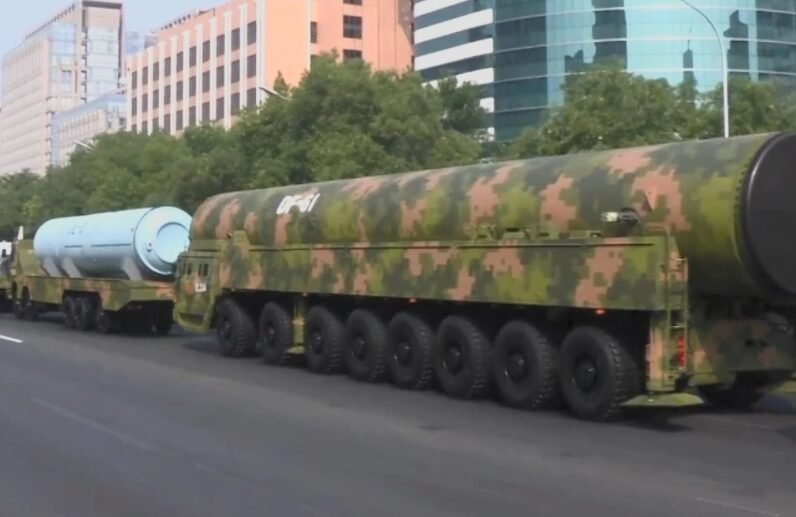
Hypersonics, Missiles, and the DF-61: China’s Expanding Global Strike Power
On 3 September 2025, the world watched China’s military parade, a display that highlighted the nation’s advancing missile technology and impressive military capabilities. At the center of this exhibition was the newly revealed DF-61 intercontinental ballistic missile (ICBM), equipped with multiple independently targetable reentry vehicles (MIRVs) and boasting an impressive range of 14,000 kilometers. This development is not just a leap for China but a significant aspect of global security dynamics, especially when viewed in the context of similar advancements from the U.S. and Russia.
The DF-61 ICBM: A New Player in Global Strike
The DF-61 represents a critical advancement in China’s ability to project power globally. Its MIRV capability allows a single missile to carry multiple nuclear warheads, increasing its effectiveness against fortified targets and enhancing deterrence.
With a range of 14,000 kilometers, the DF-61 can reach targets across the globe, covering the entirety of the continental U.S. and beyond. This long-range capability is particularly concerning as it signals China’s intention to ensure its nuclear deterrent can reach adversaries anywhere on the planet, fundamentally changing the calculus of nuclear deterrence.
Hypersonic Missiles: The Game Changer
In addition to the DF-61, China showcased advancements in hypersonic technology during the parade, particularly with the YJ-series anti-ship missiles. These hypersonic missiles are designed to travel at speeds exceeding Mach 5, enabling them to evade traditional missile defense systems.
- Speed: At hypersonic speeds, engagement time for targets is drastically reduced, complicating responses from enemy forces.
- Maneuverability: Hypersonic missiles can change course mid-flight, making them more unpredictable and harder to intercept.
- Precision: Equipped with advanced guidance systems, these missiles boast improved accuracy against moving targets, such as naval vessels.
These capabilities highlight China’s strategy to enhance its naval power and potential to challenge U.S. dominance in the Pacific.
Comparative Analysis: U.S. and Russian Equivalents
To understand the implications of China’s advancements, it’s essential to compare them with similar developments in the U.S. and Russia. Both nations have made significant strides in missile technology, particularly with hypersonics.
- U.S. Developments: The U.S. has been actively pursuing hypersonic glide vehicles (HGVs), such as the Conventional Prompt Strike system, aimed at enhancing strike capabilities without crossing into nuclear thresholds. Additionally, the U.S. Navy’s LRHW (Long Range Hypersonic Weapon) program focuses on deploying hypersonic missiles aboard naval platforms.
- Russian Advancements: Russia has also invested heavily in hypersonics, exemplified by the Avangard system and the Tsirkon missile, which is aimed at targeting naval assets at high speeds. The Dagger system combines air-launched capabilities with hypersonic speeds, presenting a multifaceted threat.
While China’s DF-61 and YJ missiles are formidable, the competition is fierce. The U.S. and Russia are also enhancing their missile technologies, and each nation’s developments push the others to innovate faster.
The Role of AI in Missile Technology
In addition to speed and range, Artificial Intelligence (AI) is revolutionizing missile guidance, precision, and decision-making in combat scenarios. The integration of AI into missile systems allows for:
- Enhanced Target Recognition: AI systems can analyze vast data sets to identify targets with greater accuracy and speed than human operators.
- Adaptive Strategies: AI can update target trajectories in real-time, responding to changes in the battlefield environment and enhancing the effectiveness of strikes.
- Operational Efficiency: AI algorithms can streamline decision-making processes, allowing for faster responses to threats.
This AI-driven evolution changes the nature of both nuclear and conventional deterrence. With enhanced strike capabilities, adversaries must adjust their defense strategies, creating a cycle of escalation in military capabilities.
Conclusion
The 3 September 2025 parade marked a significant moment in the evolution of China’s military capabilities, showcasing the DF-61 ICBM and hypersonic missiles. As onlookers, we must recognize that this advancement does not occur in a vacuum, and the responses from the U.S. and Russia are crucial to understanding future global security dynamics. As hypersonic technologies, AI enhancements, and nuclear strategies evolve, so too will the nature of deterrence in the 21st century.
For recommended tools, see Recommended tool
Disclosure: We earn commissions if you purchase through our links. We only recommend tools tested in our AI workflows.
0 Comments